 Neasden House Clearance Health & Safety Policy
Purpose: This Health and Safety policy sets out the commitment of Neasden House Clearance and associated clearance teams to maintain a safe working environment for staff, clients and the public during all house and property clearance operations. As a professional rubbish removal company and waste clearance service provider, we recognise our legal and moral responsibilities to prevent accidents, control risks and ensure safe handling of waste across every project. This document outlines the core principles, responsibilities and safety measures applied to our rubbish collection service, house clearance operations and related activities.
 Scope: This policy applies to all employees, contract operatives and sub-contractors engaged in Neasden clearance services, including domestic house clearances, commercial property clearouts, garden waste removal and general waste collection tasks. The policy covers on-site work, transportation of materials, vehicle operations, storage, segregation and disposal practices. It is designed to guide the conduct of our clearance company while remaining adaptable to site-specific risk assessments and regulatory requirements.
Responsibilities and Management
 Management will ensure that appropriate resources are allocated for health and safety. The designated safety lead is responsible for developing and maintaining risk assessments, providing training and ensuring that safety procedures are implemented consistently. All staff engaged in rubbish collection or waste clearance activities must follow safe systems of work, wear required personal protective equipment (PPE), and report hazards or incidents promptly. Contractors and temporary staff will be briefed on site-specific risks before commencing any clearance tasks.
Risk assessment and control measures: We carry out formal risk assessments prior to and during clearance projects to identify hazards and implement proportionate control measures. Key controls include:
- Manual handling procedures and use of mechanical aids where feasible to reduce the risk of musculoskeletal injury.
- Use of appropriate PPE such as gloves, eye protection, high-visibility clothing and protective footwear for all operative tasks.
- Clear segregation of waste streams to manage hazardous materials, sharp objects and regulated wastes safely.
- Safe loading practices and securement of loads for our removal vehicles to prevent shifting during transit.
- Traffic management plans and safe access arrangements on-site to protect operatives and members of the public during collections and clearances.
Training, communication and incident reporting: Neasden house clearance teams receive induction training and regular refresher courses covering manual handling, hazardous waste awareness, vehicle safety and emergency procedures. We maintain clear communication channels so all operatives can report near-misses, accidents or concerns quickly. All incidents are investigated with remedial actions implemented to prevent recurrence. The company promotes a culture where safety observations and improvement suggestions are welcomed and acted upon.
Waste handling and segregation
 Waste handling protocols are tailored to the type of material encountered. Our house clearance company ensures that asbestos-containing materials, solvents, batteries, electronic waste and other hazardous items are identified and segregated for specialist disposal. Non-hazardous items are separated for recycling where possible to minimise landfill and support environmental responsibilities. We use labelled containers and documented procedures to maintain traceability and compliance with waste regulation.
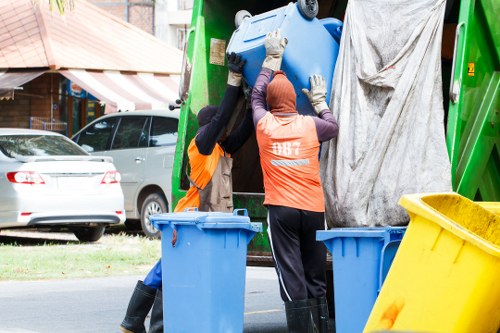 Operational controls and vehicle safety: All drivers and crew follow vehicle inspection checklists, load restraint standards and safe driving practices while performing rubbish removal and waste transportation. Vehicles are maintained under scheduled servicing regimes to reduce mechanical risks, and operatives are trained in safe loading/unloading techniques to protect both staff and the public. Our rubbish collection service applies specific controls for working at height, stairway access and confined spaces encountered during clearances.
Contractor management and subcontracted services: Where external contractors support our clearance operations, they are selected based on demonstrated competency and safety performance. Subcontractors must adhere to the same health and safety standards as our direct employees and provide evidence of insurance, training and valid certifications where required. We monitor contractor performance through audits and site inspections to maintain consistent safety standards across the service area.
Monitoring, review and continuous improvement: This policy is reviewed regularly and updated to reflect changes in legislation, operational practice and emerging risks. Routine site inspections, formal audits and performance reviews support continuous improvement. Findings from incident investigations, customer site observations and audit actions feed back into revised procedures and training programmes for the clearance team.
Health, welfare and emergency arrangements: First aid provision, emergency contact procedures and arrangements for dealing with significant incidents are established for all projects. Operatives are briefed on emergency assembly points, basic first aid measures and communication protocols. Mental health and welfare are also considered; staff are encouraged to raise concerns and access support when required.
Commitment
Neasden House Clearance is committed to delivering safe, compliant and responsible clearance services. Our aim is to protect people, property and the environment while providing a professional rubbish removal and clearance service. This policy is endorsed by senior management and is made available to employees, contractors and relevant stakeholders to ensure a shared understanding of expectations and responsibilities.
Review date and governance: This policy will be reviewed at least annually or following significant operational changes, incidents or changes in legislation. Management will ensure ongoing governance and that relevant records, risk assessments and training documentation are maintained to demonstrate compliance and continuous improvement by the clearance company.